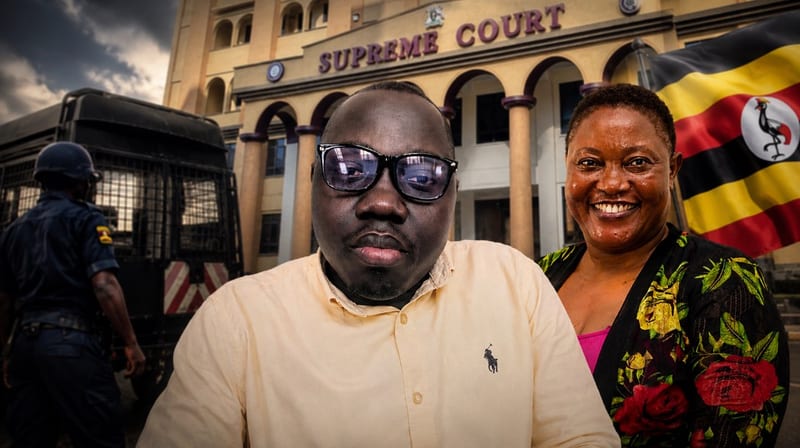
Reports have emerged from Uganda that a journalist has been detained by security agencies in Kampala after publishing a story about Minister for the Presidency Milly Babalanda, a story that had already circulated across multiple East African blogs long before he posted it on his own platform.
The journalist in question is Remmy Asiteza, the owner of dailyexpress.co.ug, who was picked up by Ugandan police and is currently being held in detention without being taken to court, a violation of basic due process that has drawn sharp criticism from press freedom advocates and journalists across the region.

His arrest came after he published a story on his blog concerning the A-RDC recruitment scandal, a matter that has already been widely reported by other outlets and has prompted President Yoweri Museveni to order a formal investigation.
Asiteza is reportedly languishing in deplorable conditions and is facing intense pressure to reveal his sources, a tactic that Uganda's security apparatus has perfected over decades of suppressing dissent.
His continued detention without charge is a flagrant violation of any semblance of constitutional protection, though such violations have long been the norm in a country where the courts are subservient to the executive and the security forces operate with impunity.
The A-RDC Recruitment Scandal: The Story That Led to Asiteza's Arrest 
The A-RDC scandal, which lies at the heart of Asiteza's arrest and detention, involves the recruitment of Assistant Resident District Commissioners (A-RDCs) and Assistant Resident City Commissioners (A-RCCs), a process that has been marred by allegations of financial irregularities and the possible embezzlement of public funds.
According to officials familiar with the matter, a whistle-blower submitted a detailed dossier to President Museveni, contending that approximately UGX 15 billion was lost during the recruitment process, while further questions have been directed toward remuneration funds that went unexplained over a two-year period.
President Museveni has, in a move that signals the seriousness with which he regards the matter, directed the Director-General of the Internal Security Organisation (ISO) to carry out a thorough and comprehensive investigation, with a report expected to be submitted within two weeks.
The inquiry is anticipated to examine the timeline surrounding the recruitment process, the manner in which appropriated funds were utilised, the authenticity of the procurement claims advanced by the internal audit, and the possibility that ghost officers may have been added to the payroll, a recurring difficulty that has long troubled Uganda's public service.
The recruitment of A-RDCs was first approved during the 2022/2023 financial year, at which point funds were appropriated for salaries and operational support, yet the officers in question were not deployed until April 2024, a delay of almost two years beyond the initial clearance of the positions.
Throughout this extended interval, the money that had been set aside was neither returned to the Consolidated Fund nor disbursed to the recruits who would eventually take up their posts, and even once the new officers assumed office in April 2024, they reportedly did not begin receiving their salaries until July 2024, coinciding with the start of the 2024/2025 financial year.
Each Assistant RDC earns a monthly salary of UGX 817,217, which amounts to UGX 9.8 million on an annual basis, together with a monthly allowance of UGX 1.5 million that totals UGX 18 million per year.
Given that 432 officers have been deployed across the country, insiders now estimate that more than UGX 24 billion intended for salaries and allowances over the two-year period remains unexplained and unresolved.
An internal audit report produced by the Office of the President contends that the funds in question were used to procure office equipment for the newly appointed officers, though multiple sources dispute this claim outright, pointing out that a considerable number of RDC offices remain poorly furnished to this day.
Several Assistant RDCs reportedly find themselves sharing office space with secretaries and other support staff, whereas others operate entirely without designated workstations of their own.
The whistle-blower's dossier contends that the procurement narrative put forward by the audit is fundamentally inconsistent with the conditions actually observed in the field, a discrepancy that has fueled suspicions of mismanagement and possible embezzlement.
The recruitment of A-RDCs had, well before these latest revelations surfaced, already encountered resistance from Parliament, whose legislators argued that expanding the RDC structure would impose an unnecessary financial burden upon taxpayers, particularly at a moment when the government was already contending with rising public expenditure across the board.
The Parliamentary Budget Committee had warned, in no uncertain terms, that the addition of these officers would increase the wage bill by more than UGX 10 billion annually, and it urged the Executive to reconsider the move before proceeding further, though the deployment ultimately went ahead once the President defended the decision as a necessary step toward strengthening supervision of government programmes nationwide.
Minister Milly Babalanda's Pattern of Scandals 
Minister Babalanda, who is the first minister in Uganda's history to serve more than one term in charge of the presidency, has been at the centre of multiple scandals during her tenure.

She has also been linked to a separate UGX 7 billion scandal at the Uganda Printing and Publishing Corporation (UPPC), which has drawn the attention of Parliament's Committee on Commissions, Statutory Authorities and State Enterprises (COSASE).
The dossier submitted to the President reportedly extends well beyond the A-RDC matter alone, drawing attention to alleged mismanagement within several agencies operating under the Office of the President, such as the Uganda AIDS Commission, the Uganda Printing and Publishing Corporation (UPPC), and the National Leadership Institute (NALI), all of which have, on previous occasions, been cited in Auditor General reports for procurement inconsistencies and gaps in answerability.
The UGX 7 Billion UPPC Scandal 
According to reports that first appeared on NilePost and were subsequently published by Daily Express, Minister Babalanda is accused of siphoning UGX 7 billion from a Kenya Commercial Bank account that had been set aside to purchase printing machines for the Uganda Printing and Publishing Corporation (UPPC).
An internal source told the publication that UPPC had been saving the money to purchase the said machines, however, the Minister expelled the Board in 2021 and took over management and procurement roles.
While performing these two roles illegally, the source maintains that the Minister depleted the UPPC coffers, with one source claiming that she personally signed out the money and that the account is now empty.
Documents further revealed that UPPC had banked substantial sums in the months leading up to the scandal, including UGX 529 million on 2nd July 2021, UGX 600 million and UGX 521 million in March of that year, UGX 3 billion in May, and UGX 4.5 billion the month before.
In August 2021, Minister Babalanda abruptly issued a directive temporarily suspending the activities of the board of governors at the government printers, a move that came just as CID operatives had swung into action and arrested Prof David Wasswa on allegations of fraud and financial mismanagement.
The Board members accused the Minister of sinister plans, claiming that sacking them without any right to hear is not only fishy but selfish, and they alleged that the minister was already biased.
The Attorney General advised the Minister that she should not violate the rules of Natural Justice that dictate that affected members of the board be granted a right to a fair hearing, however, Minister Babalanda did not heed the advice, insisting on firing the board members and replacing them with James Tweheyo just six days later.
A report from the Auditor General found the Minister culpable for usurping the roles of the board, adding that in the period the board was absent, there was no one to check the actions of management.
The Auditor General also notes that the Minister acted in an oversight role during the period the Board was absent, and sources confirm that during this period, the Minister made massive recruitment into UPPC, hence swelling the salary burdens on the payroll, which in turn cost UPPC financial loss.
As a result of these actions, Babalanda was summoned by Parliament's COSASE committee to explain the circumstances under which she signed finance documents as well as the appointment letter of the acting managing director of UPPC.
A Pattern of Impunity and Intimidation 
Despite the gravity of these allegations, the minister has not denied the reports that have been circulating across multiple platforms, but has instead chosen to target a journalist who republished a story that was already in the public domain.
Asiteza's continued detention without charge is a flagrant violation of Uganda's constitutional protections and international standards on press freedom, and his case has drawn sharp criticism from press freedom advocates, journalists, and civil society organisations across the region.
The targeting of Asiteza, who simply republished a story that was already widely available, has raised serious questions about the government's commitment to transparency and its willingness to use state power to intimidate journalists who report on corruption involving high-ranking officials.
Minister Babalanda, who has previously advocated for anti-corruption campaigns and clean governance, now finds herself at the centre of multiple scandals and accused of using her position to silence journalists who report on her alleged misconduct.
Corruption in Uganda 
The Inspectorate of Government (IGG) has, on previous occasions, estimated that the country loses somewhere between UGX 9 trillion and UGX 20 trillion annually to corruption, procurement fraud, and financial mismanagement, a figure that, remarkably, represents nearly 40% of the national budget in certain sectors.
The revelations that have now come to light appear to lend considerable weight to the concerns that Parliament had voiced at an earlier stage regarding the financial implications tied to expanding the RDC structure, given that legislators had, at the time, warned that the recruitment process could create openings for the misuse of public funds and place additional strain upon the national budget.
Further disclosures are widely anticipated as investigators proceed to review payroll records together with deployment lists, and early indications suggest that the total number of Assistant RDCs may, in fact, have been inflated beyond what official figures currently reflect, a possibility that opens up additional questions regarding answerability within the Office of the President.
President Museveni has, on numerous occasions, reiterated his commitment to combating corruption, describing it as one of the principal obstacles standing in the way of national development, and in a number of public addresses he has vowed to take firm action against any official found to be implicated in financial misconduct.
"Corruption is an enemy of progress, and those who engage in it will face consequences," he has said in past statements, and his government has, over the years, sanctioned or prosecuted officials across a range of ministries and agencies, even as watchdog groups continue to call, with growing insistence, for stronger enforcement mechanisms.
The irony of a minister who champions anti-corruption being implicated in corruption scandals and targeting journalists is not lost on observers, who see it as a stark illustration of the gap between rhetoric and reality in Uganda's fight against corruption.
The international community is watching closely, and there is growing concern that Asiteza's case could set a dangerous precedent for the treatment of journalists who report on corruption in Uganda.
Calls for Justice and Press Freedom 
Asiteza's family, colleagues, and supporters are demanding his immediate release and are calling on the Ugandan government to respect the rule of law and allow journalists to do their work without fear of intimidation or arbitrary detention.
Press freedom organisations and the international community are watching closely as Asiteza's detention continues without charge, with growing concern that his case could set a dangerous precedent for the treatment of journalists who report on corruption in Uganda.
The case of Remmy Asiteza is a stark reminder of the challenges facing journalists in East Africa, where reporting on corruption and abuse of power often comes with grave personal risk, and it shows the urgent need for stronger protections for press freedom across the region.
As the investigation into the A-RDC scandal continues and Parliament's COSASE committee pursues its inquiry into the UPPC matter, the detention of Asiteza stands as a troubling example of how those in power seek to silence those who report on their misconduct.