
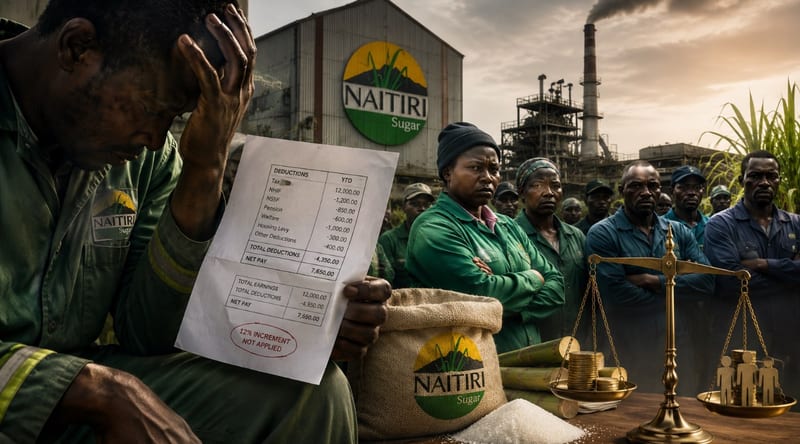
Workers at Naitiri Sugar Company, a subsidiary of billionaire Jaswant Singh Rai's expansive business empire, have raised a fresh storm over the selective application of the government's 12% salary increment, accusing management of using a litany of excuses to deny them the wage increase that was gazetted in June 2026 as a legal requirement for all workers.
The employees, who have been agitating for the implementation of the increment announced by President William Ruto on Labour Day, say they have been met with a series of contradictory explanations from the company, including claims that some workers are "overpaid," others are "above the general wage order," and that certain employees failed to submit verified certificates on time, leaving many of them frustrated and feeling cheated by a company that is part of one of Kenya's most powerful corporate conglomerates.
The complaints come against a backdrop of national confusion over the implementation of the 12% salary increment, which the government gazetted in June 2026 after President Ruto announced it as a universal adjustment for all workers during the Labour Day celebrations at Uhuru Gardens.
While the government and the Central Organisation of Trade Unions (COTU) insisted that the increment applied to all employees across the board, employers, led by the Kenya Association of Manufacturers (KAM) and the Federation of Kenya Employers (FKE), pushed back and argued that the government only has the legal authority to set the minimum wage, and that any increase beyond the statutory minimum should be negotiated between employers and employees through Collective Bargaining Agreements (CBAs).
This legal ambiguity has created a window for employers to selectively apply the wage increase, and workers at Naitiri Sugar say they are paying the price for this confusion.
The workers have outlined four main reasons that the company has given for denying them the 12% increment, and each one has left them questioning the fairness and transparency of the company's human resource policies.
The first reason given by the company is that employees who are considered overpaid in their current roles are not eligible for the increment, a justification that has angered workers who see it as a punishment for their hard work and career progression, and they argue that this rationale is being used to deny them a benefit that the government intended for all workers without exception.
The second reason offered by the company is that employees earning above the general wage order are excluded from the increment, a position that effectively interprets the general wage order as the statutory minimum wage and denies the increment to anyone earning above that threshold, a stance that directly contradicts the government's stated intention of a universal increase for all workers.
The third reason provided to workers is that those who failed to submit verified certificates within the company's deadline are not entitled to the increment, a requirement that employees say is arbitrary and has been used to exclude a significant number of workers who may have had genuine difficulties in obtaining and submitting their documents on time.
The fourth reason given is that contract or agency workers, who are not directly employed by Naitiri Sugar but are hired through third-party agencies, are outside the general wage order because their dues are set by the client, a justification that effectively absolves the company of any responsibility for their wages and leaves these workers at the mercy of their employers.
Workers have rejected the four explanations given by the company, describing them as excuses for withholding the 12% salary increment, and are demanding that Naitiri Sugar implement the wage increase across its workforce without discrimination.
They argue that the criteria being used to determine eligibility have created unequal treatment among employees and are calling on the government to intervene to ensure that the company complies with the applicable wage requirements.
The dispute at Naitiri Sugar comes against a backdrop of longstanding labour challenges in Kenya's sugar industry, which has faced recurring complaints over wage arrears, casualisation, employment conditions and limited union representation.
In 2026, workers at several sugar mills, including Nzoia Sugar, threatened a nationwide strike over years of unpaid salaries and benefits, while former workers of Pan Paper Mills, now operated by the Rai Group as Rai Paper, protested over unpaid dues and redundancies.
The latest complaints from Naitiri Sugar workers therefore add to a wider series of labour disputes that have continued to affect employees across the sector.
Naitiri Sugar is part of the Rai Group, whose sugar interests include West Kenya Sugar, Sukari Industries, Olepito Sugar and Naitiri Sugar, while the wider business empire founded by billionaire Jaswant Singh Rai extends into edible oils, cement, paper, real estate and timber processing.
The group has also faced various controversies and allegations relating to labour practices, environmental matters and community disputes across some of its operations, although the specific circumstances differ from one company or project to another.
The Naitiri Sugar workers say they feel disadvantaged by the company's position on the salary increment and are seeking government intervention to have the dispute addressed.
They maintain that if the matter is not resolved internally, they are prepared to pursue the issue before the Employment and Labour Relations Court and seek a determination on whether the company's interpretation of the wage increase and the criteria it has applied to its employees are lawful.
"Good morning Nyakundi. So many complaints have been raised from the recent payroll. Those employees who didn't get 12%, the below reasons were given; 1) If in your current role you're overpaid 2) You're above the general wage order 3) You failed to provide a verified certificate on time 4) You're outside the general wage order, meaning the client sets your dues. This is what we go through Rai group under contractor this Naitiri sugar even 12% increment is given selectively?"