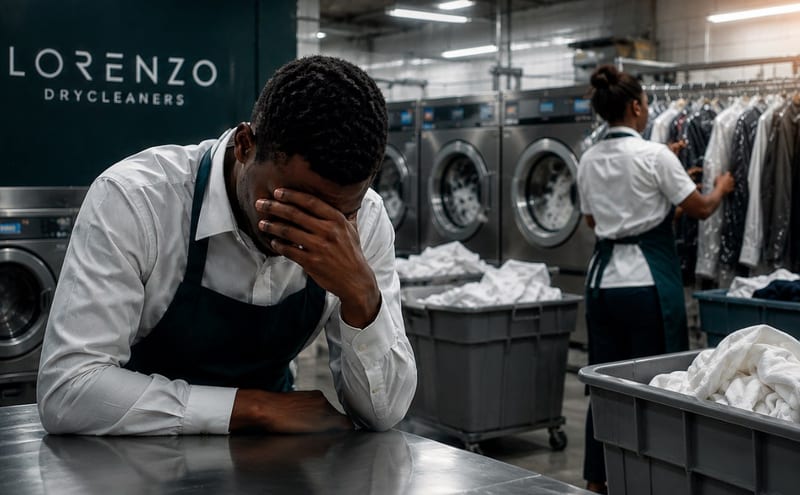
A storm is brewing behind the polished storefronts of Lorenzo Group Kenya, one of Nairobi's most visible premium garment care networks, where employees are now speaking out against what they describe as a deeply oppressive and dehumanising work environment at its Kamiti Two facility.
The company, which operates under the umbrella of Lorenzo Group and runs a chain of high-end dry cleaning outlets including Lorenzo Drycleaners, Vogue Drycleaners, Mamafua Laundry, and Dr Sportless, has built a reputation for luxury fabric care and convenience, but workers say the glittering brand image masks a culture of exploitation, intimidation, and systematic denial of basic employment rights.
The grievances centre on a workplace where employees are subjected to daily public scrutiny, arbitrary punishments, delayed salaries, and a management structure that workers say is defined by arrogance and a complete disregard for labour laws.
According to employees who spoke to this publication on condition of anonymity, the situation has become untenable, with many living in constant fear of being moved to distant locations without warning, denied their rightful pay, or dismissed without receiving their dues.
The complaints have been building for years, but employees say they have now reached a breaking point, prompting this exposé.
Salaries Delayed and Paid in Portions 
One of the most persistent grievances raised by workers at Lorenzo Group concerns the irregular and untimely disbursement of salaries.
Employees report that wages are consistently paid late and in portions, creating financial instability for workers who depend on timely payments to meet their daily obligations.
The situation is made worse by the fact that all employees are under the same bank account, meaning delays affect the entire workforce uniformly, yet no one from the relevant departments appears to take responsibility or address the root cause of the problem.
The accounts department, led by Jacklin Rotich, has been singled out by workers for failing to ensure timely salary processing, while the General Manager, Grace Mwambeo, has been accused of showing little concern for the welfare of employees and becoming increasingly irresponsible in the discharge of her duties.
The Human Resources department, headed by Faith Mbai, has also come under fire, with workers describing her as tribalistic and dismissive of employee concerns.
When workers attempt to raise complaints about salary delays or other issues, they are often met with hostility or told that the company has no shortage of qualified candidates, including people with master's degrees, who are willing to do their jobs for half the salary.
Public Humiliation and Disciplinary Measures 
Each morning, employees are required to attend a meeting where their performance from the previous day is publicly reviewed.
Workers say these sessions are not constructive but are instead used as a tool for intimidation and humiliation, with each member forced to explain what they did or failed to do the previous day.
Those who fall short of the daily targets, which workers say are often increased arbitrarily, are subjected to disciplinary measures that include being reshuffled to distant locations, a punishment that employees describe as one of the most devastating tools the company uses to assert control.
One employee recalled a scenario where a worker residing in Kawangware was suddenly posted to Kitengela or Greenpark, a move that would add hours to their daily commute and upend their family life.
Faith Mbai, the HR manager, is said to have told employees that she would keep rotating them until they could no longer bear it, a statement that workers say reflects the company's complete disregard for employee welfare.
The constant threat of being transferred to a far-flung location without any input or consideration is one of the most feared consequences of failing to meet the ever-increasing targets.
Employment Contracts, Salary Advances, and Dismissals 
Workers have also raised concerns about the company's employment practices, noting that before being enrolled, employees are required to open an account with a specific banking institution, a move they say is designed to benefit the company through interest gained on salary advances.
Employees say the company pushes workers to take salary advances, which they argue is a scheme that enriches the company at the expense of employees who are already struggling to make ends meet.
The arrangement has left many workers feeling trapped, with the company seemingly profiting from their financial struggles.
When an employee's contract ends or they are dismissed, workers say the real suffering begins, with many describing the process as a merry-go-round that leaves former employees waiting indefinitely for their dues.
According to workers, there are former employees who left over a year ago and have yet to receive their final payments, a situation that employees say is emblematic of the company's callous disregard for the wellbeing of its workforce.
Holidays, Leaves, and Working Conditions 
Workers also report that the company does not respect public holidays or employee leave entitlements, with staff required to work even during national strikes and demonstrations.
Those who fail to report for duty are issued warning letters that could lead to dismissal, leaving employees with no choice but to comply.
Employees are not provided with breakfast or lunch, and workers say they are also not allowed to bring their own meals, with management claiming they have too much work to do.
The company operates with a replacement mentality, workers say, where employees are told they are replaceable regardless of their performance, a statement that creates an atmosphere of fear and insecurity among the staff.
The constant pressure to perform, coupled with the threat of being replaced at any moment, has created a workplace where employees feel disposable and undervalued.
Workers say the arrogance displayed by management is unmatched, and the culture of fear and intimidation has made it impossible for anyone to speak up without fearing for their job.
The Structure Behind the Brand 
Lorenzo Group Kenya is a prominent private investment company headquartered at the Lorenzo Group Centre on Tigoni Road in Kilimani, Nairobi, having been founded in 2013 as a private investment vehicle that allocates capital toward highly sustainable and tech-forward industries.
The group splits its long-term investment capital across three key divisions, with retail and consumer services serving as its flagship division, operating Kenya's largest premium garment care network, alongside commercial real estate development and digital technology investments.
The retail arm, operating under the legal name Lorenzo Drycleaners Ltd, serves as the core consumer engine of the group, with a network that has grown from 17 branches to more than 30 strategic locations and pick-up hubs across Nairobi's elite shopping centers.
The company's branches include flagship locations at Adlife Plaza in Kilimani, Village Market in Gigiri, The Waterfront in Karen, and Westgate Shopping Mall in Westlands, with extended operating hours that cater to Nairobi's high-end clientele.
However, for the employees working at the Kamiti Two facility and other locations, the glamour of the brand and the comfort of its elite customers stand in stark contrast to the daily reality they face.
Workers Call for Government Intervention 
Workers say the company that presents itself as a leader in premium fabric care has failed to extend the same level of care and professionalism to its own workforce, and they are now calling on the relevant authorities, including the Ministry of Labour and Social Protection, the National Employment Authority, the Salaries and Remuneration Commission, and the parliamentary committees responsible for labour oversight, to step in and investigate the exploitation that has become deeply entrenched in the company's operations.
The employees are demanding accountability, fair treatment, and respect for their rights, and they hope that by bringing these issues to the public's attention, the company will finally be compelled to change its ways.
The workers are urging the Ministry of Labour to conduct an independent audit of the company's employment practices, including salary disbursement, contract management, and compliance with labour laws.
They are also calling on the National Employment Authority to examine the recruitment processes and ensure that all employees are treated fairly and without discrimination.
The employees further appeal to the Salaries and Remuneration Commission to review the wage structures at Lorenzo Group and determine whether the pay and benefits meet the standards set for similar roles in the industry.
The workers have also expressed hope that the parliamentary committees on labour and social welfare will take up the matter and compel the company's management to appear before them to answer for the grievances raised.
They believe that parliamentary oversight would bring much-needed transparency to the company's operations and pressure management to address the systemic issues that have plagued the workforce for years.
The employees remain hopeful that the relevant authorities will act swiftly and decisively, as the situation has become untenable and many workers are on the brink of giving up.
They say they have been silenced for too long, and they are now counting on the government and the public to stand with them in their fight for justice.
Below is the full testimony from a source with direct knowledge of the working conditions at Lorenzo Group's Kamiti Two facility, detailing the systematic denial of employment rights.
"Good afternoon Nyakundi. Hide my identity. Help me expose this group of companies under Lorenzo Group with the following subsidiaries: Lorenzo Drycleaners, Vogue Drycleaners, Mamafua Laundry, and lastly Dr Sportless. My sister works here, and the working environment is messy and not friendly at all, such that I would not refer or recommend anyone to go look for work there. It is located in Kamiti Two. Employees are denied their employment rights and freedom, whereby when you try to complain, the General Manager, Grace Mwambeo, will confidently tell you that they have people with master's degrees who are looking for the work you do and would be paid half the salary they pay current employees. All departments, including Logistics, Customer Service, and the Home Cleaning team, are under pressure.
(1) SALARY DISBURSEMENT
Salaries are paid late and in portions, considering all employees are under the same bank account. When it reaches the 5th of every month, no one from the relevant departments—Accounts, led by Jacklin Rotich, the General Manager who is becoming increasingly irresponsible in her duties, and lastly HR, who is none other than a tribalistic person, Faith Mbai—takes responsibility.
Each and every morning, they conduct meetings where each member is publicly required to disclose what they did or failed to do the previous day. Failure to hit the daily increased targets results in disciplinary measures, including reshuffling, which is the most severe punishment the company can impose on an employee. For example, if you reside in Kawangware, you may be posted to Kitengela or Greenpark, and Faith Mbai will confidently tell you, "Nitakuzungusha hadi hutaamini."
(2) EMPLOYMENT
Before you are enrolled in the company, you are required to open an account with a specific banking firm, through which one can apply for a salary advance. This arrangement benefits the company more, as it gains interest from employees.
(3) END OF CONTRACT OR DISMISSAL
When your contract ends or you are dismissed, that is where the suffering begins. It is a merry-go-round here; you may die without receiving your dues. It is evident that some former employees who left a year ago have still not been paid to date. The arrogance in this company is unmatched.
(4) HOLIDAYS, OFF DAYS, AND LEAVES
Even when the country is under massive strikes and demonstrations, you are required to work at Lorenzo whether you like it or not. Failure to report for duty results in a warning letter that could lead to dismissal. Employees work on public holidays, and when they ask for compensation, the response is that the company has fewer workers, yet they employ people daily from Monday to Friday. No breakfast or lunch is provided, and employees are also not allowed to bring their own meals, with management claiming they have too much work to do. Employees are told that they are replaceable regardless of their performance."