
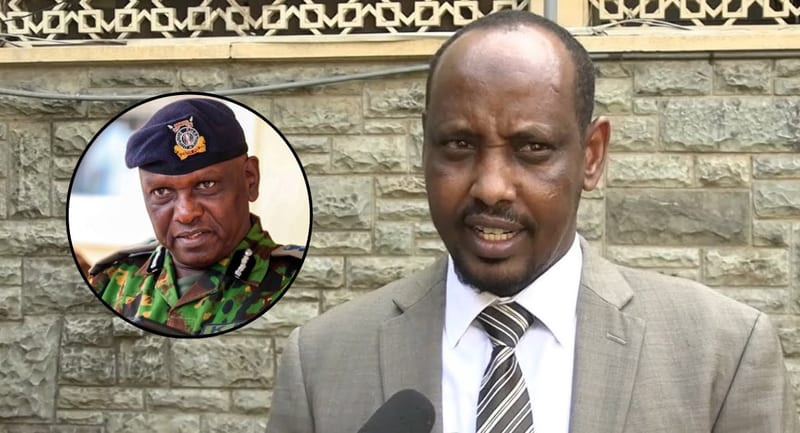
Wajir North MP Ibrahim Abdi Saney has written directly to Inspector General of Police Douglas Kanja demanding urgent action on what he frames as a rapidly deteriorating security picture along the frontier separating Kenya from Somalia, a letter in which he contends that certain senior police commanders stationed in the area have themselves become entangled in unlawful cross-border dealings rather than working to stop them.
The correspondence arrives against a backdrop of mounting complaints from residents about a surge in cross-border criminal activity, drug trafficking chief among the offenses drawing public frustration, and within his letter the legislator contends that Officers Commanding Police Divisions (OCDs) serving in the region have taken part in illicit trade arrangements with certain members of the local population, arrangements he says have opened the door to the movement of narcotics and firearms across the border with troubling ease.
Saney's letter traces a direct line between this suspected commander level involvement and a broader collapse in public trust, arguing that law enforcement's ability to function has been badly weakened, that residents' safety has been placed in jeopardy, and that the population's faith in the National Police Service has eroded as a result.
"The situation has greatly undermined law enforcement efforts, threatened the lives and future of our communities, compromised public safety, and eroded the community's confidence in the police service," Saney wrote.
Building on that framing, he pressed the Inspector General to authorize a transparent inquiry into the claims and to move swiftly on the administrative front by pulling the current OCDs out of their posts and rotating in a fresh set of officers, a step he believes is necessary to restore order and integrity within the affected divisions.
"I kindly request your prompt intervention, transparent investigations and the immediate transfer of the current OCDs to other stations and the deployment of new officers to restore integrity, law and order within the divisions," he said.
This was not, by Saney's own account, the first time he had raised the matter with police leadership, and he indicated that he remained hopeful the institution would treat the issue with the seriousness it warranted this time around, arguing that further delay would only deepen the security crisis along the border and put the wellbeing and livelihoods of local residents at greater risk.
For its part, the National Police Service has indicated that the claims are presently the subject of active investigation and that no disciplinary or administrative steps will be taken until that process runs its course, and a special team has already been dispatched to the area to examine the claims firsthand and to formulate recommendations on how the situation should be handled going forward.
Residents of the affected divisions have, for some time, voiced frustration over the rising tide of crime in the region, directing pointed criticism at local security chiefs whom they accuse of sitting idle rather than confronting the problem, and describing a local environment in which, according to residents, defilement cases have been quietly compromised and police officials have accepted bribes, with residents maintaining that supporting evidence exists in relation to both of the police divisions under discussion.
It bears noting, nonetheless, that the claims made in Saney's letter remain unconfirmed, and that no supporting documentation was attached to substantiate the accusations leveled against the named commanders.
Saney took to social media on Wednesday to press the issue further, stating that he had spent an extended period drawing attention to suspected illicit trade tied to the OCPDs serving Wajir North and Korondile, and stressing that these were not new grievances but ones he had submitted in writing to Inspector General Kanja on multiple occasions over time, adding that relevant authorities, the Directorate of Intelligence among them, were already familiar with the substance of his complaints.
"For a long time, I have consistently raised concerns about alleged illicit trade involving OCPDs Wajir North and Korondile. These complaints did not begin yesterday. I have submitted several written complaints to Inspector General Douglas Kanja over an extended period, and the relevant authorities, including the Directorate of Intelligence, are aware of these concerns."
He went on to characterize the current turn of events as, in his view, an effort to redirect public attention away from the very issues he had spent so long trying to surface, flatly rejecting any suggestion that he himself bears any connection to criminal conduct.
"What is happening now appears to me to be an attempt to shift attention away from the issues I have raised. I reject any attempt to associate me with criminal matters in which I have absolutely no involvement," he said.
He further insisted that law enforcement ought to pursue and apprehend genuine offenders irrespective of identity or rank, rather than invoke his name as a means of deflecting from complaints that had already been formally lodged, while affirming his readiness to cooperate fully with any lawful inquiry that follows.
"My position is straightforward: law enforcement should investigate and apprehend those who have committed crimes, regardless of who they are, but they should not use my name to divert attention from legitimate concerns that have been formally reported. I remain ready to cooperate with any lawful investigation."
Kanja, for his part, indicated that he intended to wait for the ongoing investigation to run its course before determining what action, if any, would follow. Members of the public likewise used social media to challenge senior police officers over what they characterized as inaction in the face of climbing crime figures in the area.
Separately, it has come to light that a number of junior officers stationed in the region have lodged their own internal complaints against senior colleagues, accusing them of subjecting junior staff to harassment and humiliation, a matter now under the review of the Internal Affairs Unit, whose personnel have already traveled to the Bute area as part of their fact finding process.
North Eastern Police Commander Pepita Ranka indicated that the matter was being handled internally and in a manner consistent with professional standards.